NEWS
2026.01.10
Accepted in Journal of Aero Aqua Bio-mechanisms
Associate Professor Daigo Terutsuki and Associate Professor Toshiyuki Nakata of Chiba University, together with their research group, have obtained new insights into odor-tracking drones that employ insect antennae as sensors. Specifically, they clarified how sensor placement and propeller-induced airflow generated by the drone influence odor detection performance. These results have been published in Journal of Aero Aqua Bio-mechanisms (JAAB).
In recent years, increasing attention has been paid to drone-based odor source localization for applications such as disaster response and infrastructure inspection. Bio-hybrid odor sensors based on insect antennae, commonly referred to as electroantennography (EAG) sensors, offer exceptionally high sensitivity and selectivity. However, the influence of propeller-induced airflow generated by the drone itself on odor detection has not been sufficiently understood.
In this study, the relationship between propeller-induced airflow and sensor placement, and their combined effect on odor detection performance, was systematically investigated. Computational fluid dynamics (CFD) analyses were combined with odor detection experiments using a drone equipped with silkworm moth antennae. Detection rate and signal strength were evaluated while varying the sensor position on the drone.
The results revealed that the airflow generated by the propellers draws air from a wide region surrounding the drone, and that placing the sensor above the propeller plane significantly enhances both the odor detection rate and signal intensity. At this position, the local airflow velocity around the sensor was comparable to the airflow generated by insect wing fanning, creating conditions consistent with biological olfactory sensing mechanisms. In contrast, when the sensor was placed at excessively high positions, increased response variability was observed due to unsteady airflow, indicating that an optimal and stable sensor placement exists rather than simply the highest possible position.
These findings demonstrate that the performance of odor sensors mounted on drones is strongly influenced not only by the sensor element itself but also by the aerodynamic characteristics of the drone and the sensor placement. Rather than treating odor sensors as passive elements affected by airflow, this study highlights the importance of a design philosophy that actively leverages airflow. The results provide valuable design guidelines for future odor-tracking drones and bio-inspired robotic systems, including aerodynamic considerations for odor sensing.
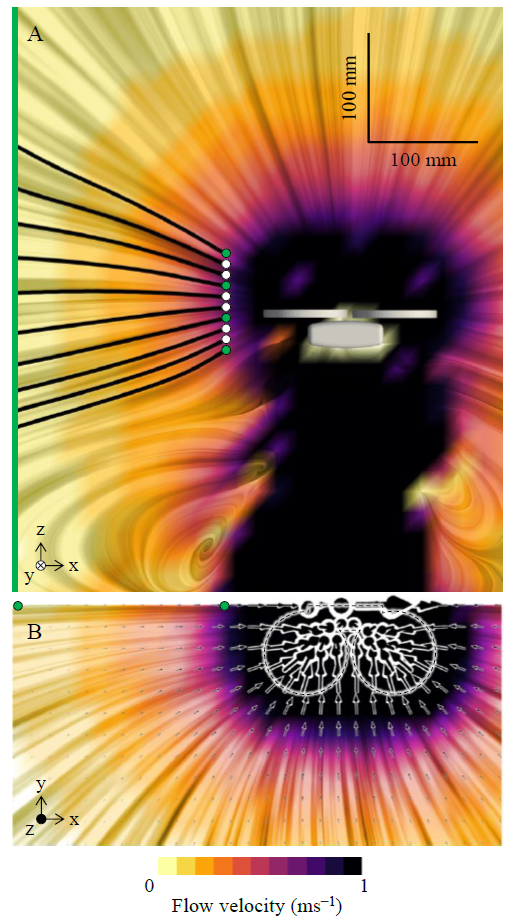
Figure: Flow entrainment toward the sensor caused by propeller-induced airflow revealed using CFD analyses.
Title: Effect of the wake induced by a drone on olfactory sensing
Authors: C. Fukui, J. Hoshina, S. Shimakawa, Y. Yamamoto, H. Liu, D. Terutsuki*, T. Nakata* *Authors for correspondence.
Journal: Journal of Aero Aqua Bio-mechanisms
DOI: 10.5226/jabmech.11.28
URL: https://www.jstage.jst.go.jp/article/jabmech/11/1/11_28/_article/-char/en
In recent years, increasing attention has been paid to drone-based odor source localization for applications such as disaster response and infrastructure inspection. Bio-hybrid odor sensors based on insect antennae, commonly referred to as electroantennography (EAG) sensors, offer exceptionally high sensitivity and selectivity. However, the influence of propeller-induced airflow generated by the drone itself on odor detection has not been sufficiently understood.
In this study, the relationship between propeller-induced airflow and sensor placement, and their combined effect on odor detection performance, was systematically investigated. Computational fluid dynamics (CFD) analyses were combined with odor detection experiments using a drone equipped with silkworm moth antennae. Detection rate and signal strength were evaluated while varying the sensor position on the drone.
The results revealed that the airflow generated by the propellers draws air from a wide region surrounding the drone, and that placing the sensor above the propeller plane significantly enhances both the odor detection rate and signal intensity. At this position, the local airflow velocity around the sensor was comparable to the airflow generated by insect wing fanning, creating conditions consistent with biological olfactory sensing mechanisms. In contrast, when the sensor was placed at excessively high positions, increased response variability was observed due to unsteady airflow, indicating that an optimal and stable sensor placement exists rather than simply the highest possible position.
These findings demonstrate that the performance of odor sensors mounted on drones is strongly influenced not only by the sensor element itself but also by the aerodynamic characteristics of the drone and the sensor placement. Rather than treating odor sensors as passive elements affected by airflow, this study highlights the importance of a design philosophy that actively leverages airflow. The results provide valuable design guidelines for future odor-tracking drones and bio-inspired robotic systems, including aerodynamic considerations for odor sensing.
Figure: Flow entrainment toward the sensor caused by propeller-induced airflow revealed using CFD analyses.
Title: Effect of the wake induced by a drone on olfactory sensing
Authors: C. Fukui, J. Hoshina, S. Shimakawa, Y. Yamamoto, H. Liu, D. Terutsuki*, T. Nakata* *Authors for correspondence.
Journal: Journal of Aero Aqua Bio-mechanisms
DOI: 10.5226/jabmech.11.28
URL: https://www.jstage.jst.go.jp/article/jabmech/11/1/11_28/_article/-char/en